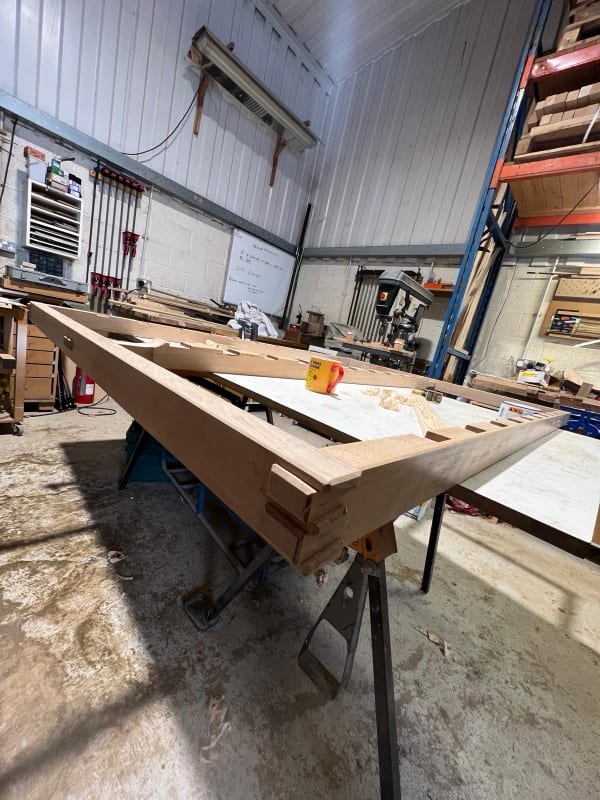
There is no wall to hide behind.
Fitted joinery has one enormous advantage that nobody mentions: three of its sides are against plaster. A freestanding piece has no such luxury. It gets walked around, seen from the side, looked down on and, sooner or later, looked at from underneath by someone moving it. Every face has to be finished as though it were the front, because at some point it will be.
That changes how a piece is built rather than just how it is finished. Joints show, so they have to be cut to be seen, and their proportion becomes part of the design. The back of a dresser is a surface, not a panel to be got away with. The underside of a table gets a chamfer because your knee will find the edge that does not have one.
It also means the piece has to stand on its own visually. Fitted work borrows authority from the architecture around it. A table in the middle of a room borrows nothing, so its proportions have to be right on the first attempt.
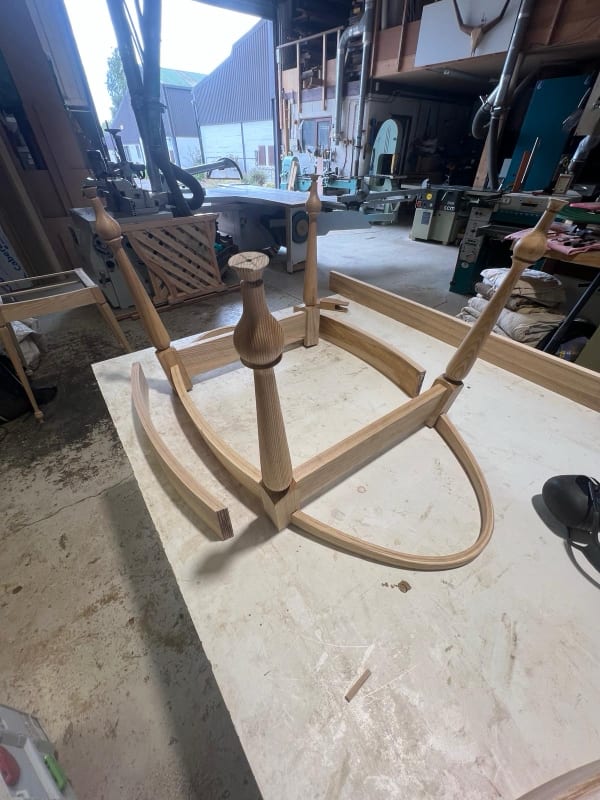
The frame is the piece. Everything else is a surface on top of it.
Solid timber moves, and it has to be allowed to.
A board takes up and gives off moisture with the seasons, and it does so across the grain rather than along it. A wide solid top will be measurably wider in a damp autumn than in a dry week in February with the heating on. Screw that top down rigidly at both ends and something has to give, which is where a split down a beautiful board comes from.
So the movement is designed in. A top is held with fittings that let it slide, panels sit loose in their grooves rather than glued in, and the end of a long top can be capped in a way that keeps it flat while still letting it breathe. None of this is visible in the finished piece. It is simply the difference between furniture that lasts and furniture that cracks.
Choosing the board matters as much as the construction. I work in oak, ash, elm, cherry, walnut, sycamore, sweet chestnut and burr oak from sustainable British suppliers, and for a single piece the figure in one particular board can set the whole design. Burr oak and elm are worth putting somewhere they get looked at properly, which is exactly what a freestanding piece is.
- Tops fixed so they can move with the seasons
- Panels floating in their grooves, never glued tight
- Joints cut to be seen, and proportioned as part of the design
- Every face finished, including the ones normally hidden
It leaves with you.
A fitted kitchen belongs to the building. A commissioned table belongs to you, goes in the van when you move, and is still doing its job in a house that has not been built yet. That is a genuinely different proposition, and it is the reason people commission a piece for a particular occasion rather than a particular room.
There is no consent to consider, no survey of an alcove, no access route to worry about beyond the front door on delivery day. What is left is the making, which is the part I would do anyway.
How a piece gets started.
Usually with something vague. A photograph you have kept, a piece of furniture in your family that you want the feel of rather than a copy of, or simply a space and a use: somewhere to eat that seats eight without the end chairs being in the doorway. Vague is a fine starting point. It is my job to turn it into drawings.
From there the conversation is about proportion, timber and how the piece is going to be used, since a desk that will be written on daily and a hall table that will hold keys and post ask for different construction. I can develop the design with you from scratch or work from an interior designer's or architect's drawings.
Commissions are priced individually, because size, timber and the complexity of the joinery vary too much for a starting figure to mean anything useful. The first conversation is free and obliges you to nothing, and nothing is cut until you have a written quote in front of you covering every part of the piece.
Four stages. One maker.
The idea
A free conversation, usually at your home, about the use, the room it will live in and whatever reference you have kept.
Drawings
Proportions worked out on paper, developed with you or from your designer's plans, until the piece is right on the page.
At the bench
Boards selected for this piece, then cut and joined by hand in my workshop at Little Horwood.
Delivered
Brought to you finished. Nothing to scribe and nothing fixed to your walls, so it can be moved whenever you like.
Fine Furniture, town by town.
Other work.
Frequently asked questions
What kinds of pieces do you make?
Freestanding work in native English hardwood: dining tables, desks, side tables, dressers and freestanding shelving among them. If you have something else in mind, describe it and I will tell you honestly whether it is a piece I can make well.
What does a commission cost?
Each one is priced individually, because size, timber and the complexity of the joinery move the figure too much for a starting price to be useful. The first conversation costs you nothing, and an itemised written quote follows it, which you agree before anything is cut.
Can you work from a photograph or a rough sketch?
Yes, and that is how most commissions start. A photograph, a family piece you like the feel of, or just a use and a room is plenty to begin with. Turning that into proportions and drawings is part of the job rather than something you need to arrive with.
Will a solid timber top split or warp?
Not if the construction allows for movement. Solid timber takes up and gives off moisture with the seasons and moves across the grain as it does. Tops are fixed with fittings that let them slide, and panels float in their grooves rather than being glued tight, which is what stops a board from splitting.
How do you choose the timber for a piece?
By looking at the use, the room and the individual boards. Oak, ash, elm, cherry, walnut, sycamore, sweet chestnut and burr oak all come from sustainable British suppliers. For a single freestanding piece the figure in one particular board can set the whole design, which is not true of a long fitted run.
Can you match a piece of furniture I already own?
I can design something that sits comfortably alongside it, taking the proportion, the timber and the detailing as a reference. What I will not do is present a reproduction as though it were the original piece. Tell me which qualities matter to you and the design can carry those.
Does a commission need planning or listed building consent?
No. Consent questions apply to work that alters a building, so freestanding furniture sits outside all of it. Even in a listed house, a table or a dresser that is not fixed to the fabric needs no consent, which is one reason a freestanding piece is sometimes the better answer.
How is a piece delivered?
Finished, by me. There is nothing to scribe and nothing fixed to your walls, so delivery day is about getting the piece through the door and into position rather than a fitting job. Access is still worth mentioning early if there is a tight stair involved.
Can you work with my interior designer?
Yes, and I do so regularly. I can build from your designer's or architect's drawings, or develop the piece with you directly from nothing. Either way the person drawing the details is the person cutting them.
How should a piece be looked after?
The finish is chosen for the way the piece will be used, and I will tell you what it needs when it is delivered. A hand applied finish on a well made piece can be refreshed in place rather than stripped, which is one of the practical advantages of solid timber over a factory finished panel.
Let's make something
If you have a piece in mind, even loosely, that is enough to begin. Tell me what it has to do and where it will live, and I will tell you honestly whether it is a commission worth making.