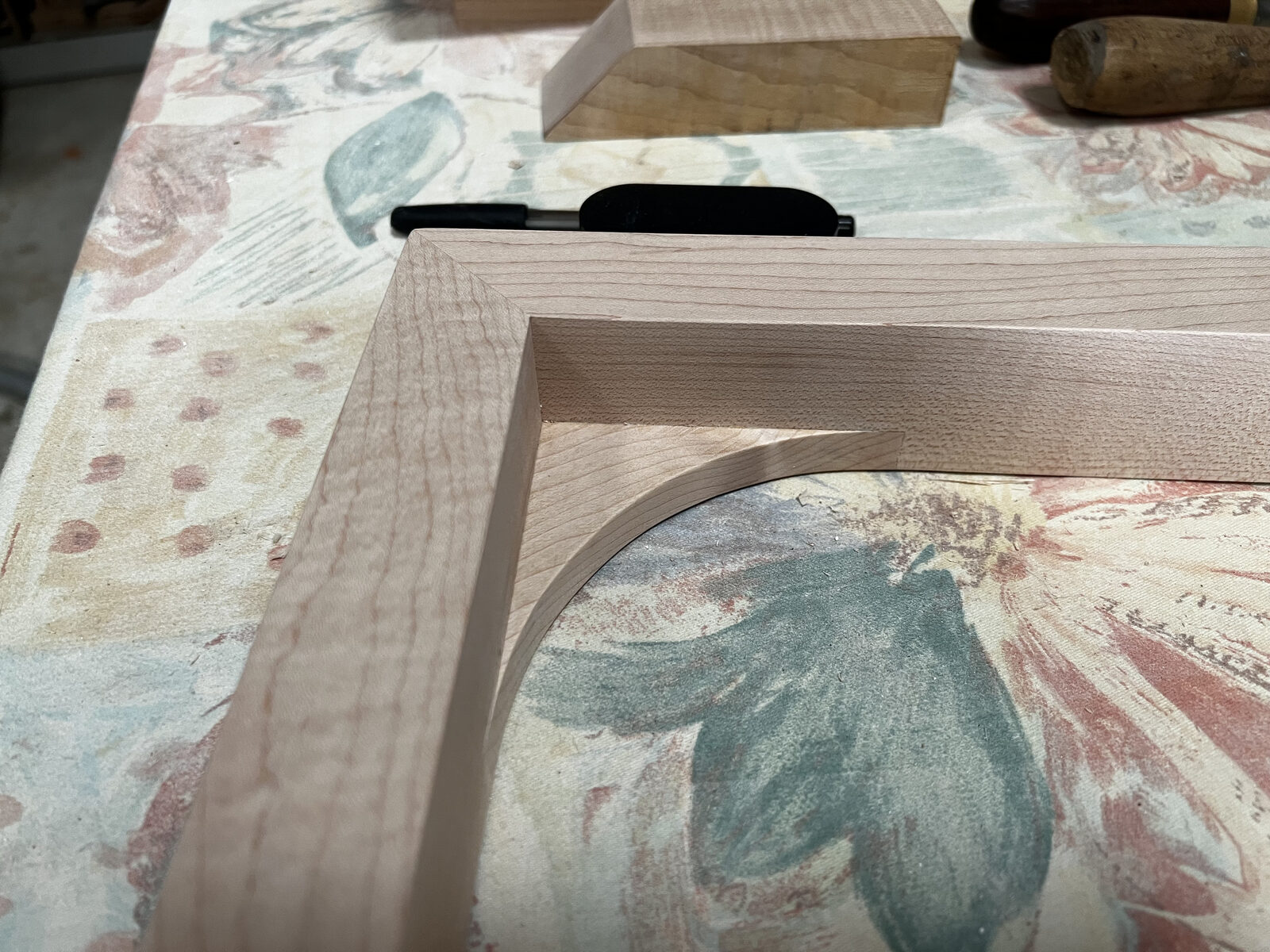
The room settles the dimensions, not the brief.
Oxford runs from the medieval core through Victorian terraces to interwar suburbs, and those three things often sit within a few streets of each other. A dining table drawn for one of them is the wrong object in the other two. So the first figures I take are the room's rather than the piece's: clear floor, pinch points, and where somebody will actually push a chair back and walk behind it.
Most people arrive with a length in mind, and length is usually the least important number in the room. What decides whether a table works is the space left around it, which wants to be somewhere near 900mm to get a chair out and pass behind, and rather less than that if the gap sits in front of a doorway. In a big room a long table can still look mean. In a tight one, a top 200mm shorter turns a squeeze into a room you can move through.
So I chalk the footprint on the floor at the first visit and stand a board on edge where the piece will go. It takes ten minutes and settles questions that no drawing on a screen ever quite does. The postcode is not what decides this. The room is.
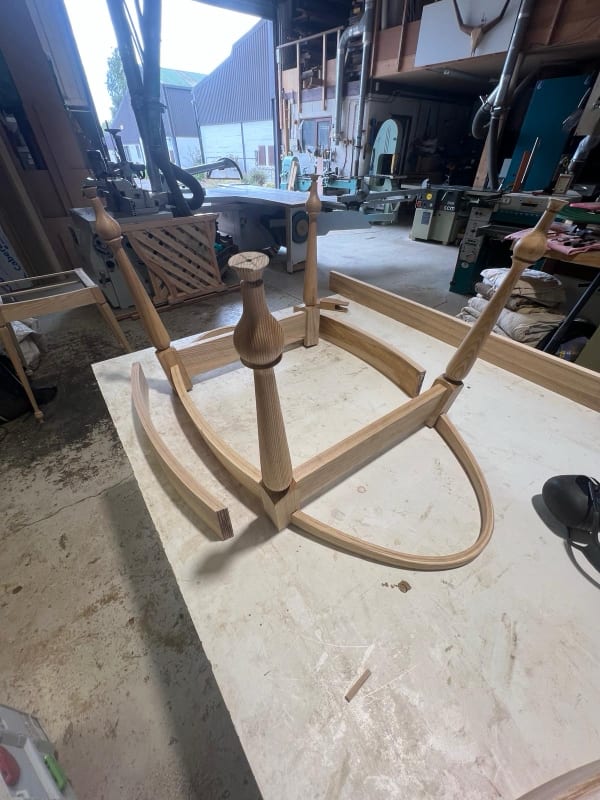
Drawn to the floor it will stand on.
Two Oxford houses, two different pieces.
Oxford City Council has eighteen conservation areas, and the housing inside them is not one type of house. A thick walled stone building with deep window reveals, a bay fronted Victorian terrace, and a 1930s semi with a squarer plan will each carry a different piece of furniture well and the other two badly.
The variable is scale rather than style. A desk under a small opening in a thick wall needs some mass about it to hold its own in the room. Put that same desk in a light interwar back bedroom and it reads heavy and slightly grim. A dresser sized to fill a Victorian chimney wall properly would swamp a modern rear extension where the glazing is doing all the talking.
This is the reason I would rather stand in the room than be sent photographs of it. Ten minutes in the space tells me more about proportion than a fortnight of correspondence, and it costs you nothing.
Every finished piece has a route to travel.
Fitted joinery has a way out of tight access: build it in sections and assemble it against the wall. A freestanding piece has no such escape, because its rigidity is the whole point of it. It has to travel as an object through whatever the house provides, which in Oxford might be a wide Edwardian hall or a basement stair narrower than the front door.
So the route gets measured alongside the room. Door width, the diagonal through the frame, headroom on a landing, and whether a top can travel separately from the frame it sits on. Where the route will not take the piece you have described, I would rather tell you at the survey and design something that goes in, than deliver a beautiful table to your pavement.
Which board suits the room depends on the windows.
Aspect and the size of the openings do more to a timber than any sample card can show you. A north facing Victorian back room takes ash, sycamore or a quieter oak, because those hold what light there is instead of eating it. A tall south facing room with a deep bay will carry walnut, elm or burr oak and show the figure properly rather than letting it go muddy.
I work in native English hardwoods only: oak, ash, elm, cherry, walnut, sycamore, sweet chestnut and burr oak, from sustainable British suppliers. For a single freestanding piece one particular board can set the whole design, which is why that choice is better made standing in the room than made off a sample in a workshop thirty miles away.
The planning authority for the city is Oxford City Council, which has eighteen conservation areas within its boundary. Designation of that kind bears on external alterations and on permitted development rights rather than on what stands in the middle of a room.
A commissioned freestanding piece sits outside consent altogether, and the reason is worth stating plainly: it is not fixed to the building, so it alters nothing about the building. No planning permission and no listed building consent, even where the property is listed. That is a genuine advantage rather than a technicality. In a listed Oxford house, fitted joinery may well need consent from the city council's conservation officer, while a table, a dresser or a run of freestanding shelves needs none at all. Where consent looks slow or uncertain, a commission is often how people get the thing they actually wanted.
Other rooms in Oxford.
Frequently asked questions
How do you decide the size of a table for my Oxford room?
By measuring the room and marking the piece out on its floor. I chalk the footprint, stand a board where the piece will sit and check the clearance for pulling a chair out and walking behind it. Length is the number people arrive with, but circulation is the number that decides whether the piece works.
Do I need planning permission for a commissioned piece in Oxford?
No. Oxford City Council has eighteen conservation areas, and designation of that sort governs external work and permitted development rather than the contents of a room. Freestanding furniture is not development at all, so nothing is required.
My Oxford house is listed. Can I still commission furniture?
Yes, and with no consent to apply for, because a freestanding piece is not fixed to the fabric of the building. That is a real difference from fitted joinery in a listed house, where altering original plaster, boards or joinery generally does need listed building consent from the council.
Will the finished piece get through my front door?
That gets measured at the survey along with the room. I take the door width, the diagonal through the frame and the turn of any stair involved. If the route will not take the piece as described, the design changes before it is built rather than after.
What does a commission cost?
Each one is quoted individually after the first conversation, because size, timber and the complexity of the joinery move the figure too much for a published number to help you. The first visit is free and obliges you to nothing, and an itemised written quote comes before anything is cut.
Which timber works in a north facing room?
Ash, sycamore and a quieter oak, generally. They keep a dim room open rather than closing it down. Walnut, elm and burr oak want more light than a north facing Oxford back room usually offers, so I would put those where the windows can do them justice.
Can a new piece sit alongside original joinery?
Yes, and the way to do it is not imitation. A plainly proportioned piece in a good native hardwood holds its own next to original shutters, skirtings or a period fireplace, where a reproduction of the same period tends to look like a copy standing next to the real thing.
How long does a commission take?
That is set out in your written quote rather than advertised, because a side table and a large dining table in figured timber are not remotely the same job. Once the design is agreed you get a timescale in writing, and I do not take on more work than I can build myself.
Do you work with interior designers in Oxford?
Regularly. I can build from your designer's or architect's drawings, or develop the piece with you from nothing but a use and a room. Either way the person drawing the detail is the person cutting it, because nothing here is subcontracted.
Do you make chairs?
No. Seating and upholstered work are somebody else's trade and I will say so rather than take the job. What I make is tables, desks, side tables, dressers, freestanding shelving and boxes, all in solid native hardwood.
Let's make something
If you have a room in Oxford and a piece in mind, the useful first step is me standing in it with a tape measure. Free, no obligation, and you get a straight answer about proportion before anything is drawn.