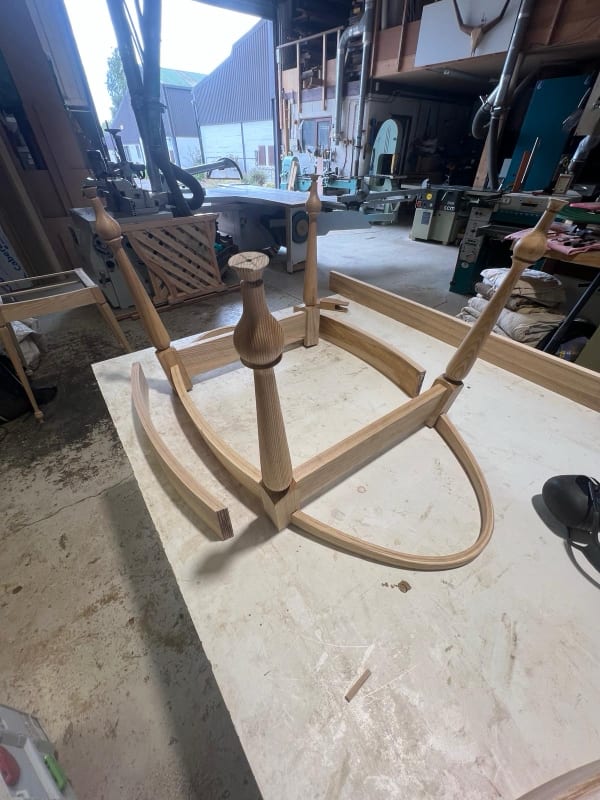
A big room makes an under-sized piece look lost.
Summertown sits at the northern end of the North Oxford Victorian Suburb, laid out from the 1850s onward in large detached and semi-detached villas. Ceilings are tall, the bays are deep, and the good rooms are wide enough that a piece of furniture bought off a shop floor tends to look like a scale model of itself once it is in position.
Height is the number people forget. A dresser or a bookcase in a room with a cornice several feet above your head has to be tall enough to relate to that cornice, or it reads as a low object floating on a large wall. A table needs enough visual weight under it to hold the floor: a slender frame that looks elegant in a terrace can look spindly under three metres of air.
None of that means heavy. It means the proportions get worked out for this room rather than borrowed from a standard. A thicker top with a deeper chamfer under the edge, a taller stretcher, legs squared up by a few millimetres. Those adjustments are invisible individually and they are the difference between a piece that owns the room and a piece the room swallows.
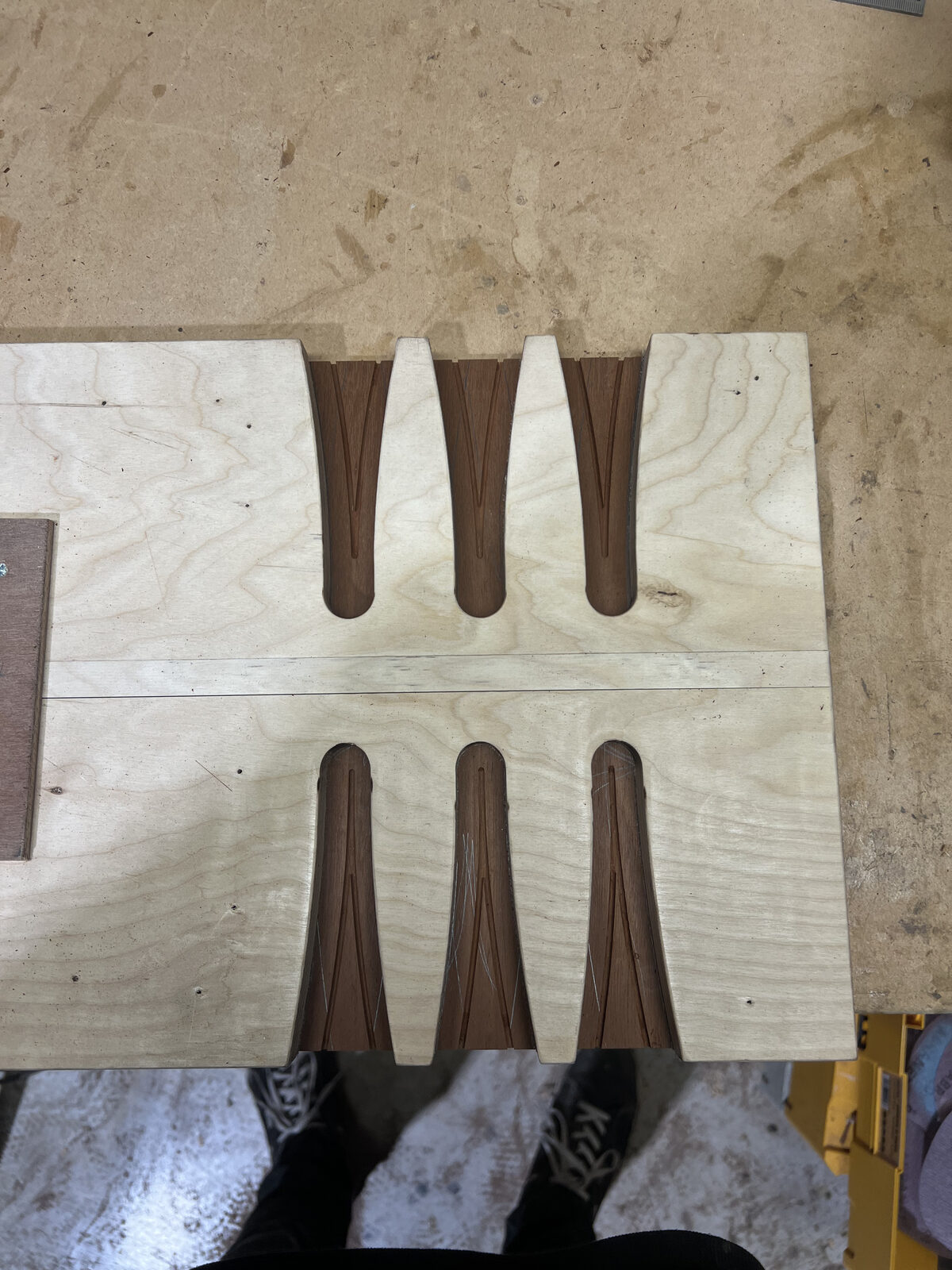
Proportioned for a tall room, not shrunk to fit a photograph.
A deep bay is a room within the room.
The bays in these villas are not decoration, they are usable floor with light on three sides. That makes them the best place in the house for a desk, and a desk in a bay is a specific commission rather than a general one: the depth is set by the reveal, the width by the window mullions, and the whole thing wants to be facing the way the light comes rather than facing a wall.
The same bay will take a side table, a small round table for two, or a low run of shelving under the sill that stops short of the shutters so they still fold back. What it will not take is a rectangular piece pushed in at random, because a bay is usually a canted shape and a square object in it leaves two wedges of dead floor that you notice every time you walk past.
So I draw the bay properly, angles and all. If the shutters work, they get measured open and closed, since a piece that blocks a working shutter has cost you something the house came with.
Holding its own next to Victorian joinery.
A villa of this era arrives with a great deal of built-in character already: moulded skirtings, picture rails, panelled doors, a chimney piece with real presence. A new freestanding piece has to stand next to all of that without either disappearing into it or arguing with it.
The way that fails is pastiche. A newly made piece detailed in nineteenth century pattern-book mouldings sits beside genuine nineteenth century joinery and loses, every time, because the eye reads the comparison instantly. What works is quieter: honest proportion, joints cut to be seen, one good board given room to be looked at, and no decoration that is not doing a job. That reads as a piece of its own time and sits comfortably with the room instead of competing with it.
Tall sashes mean you can use the darker timbers.
Rooms with full height sash windows and a bay have light to spare, and that opens up the end of the timber list that a small dark room cannot carry. Walnut keeps its depth here rather than going flat. Elm and burr oak have figure that needs light across it before it means anything, and in these rooms it gets it.
Cherry is worth a mention for the same reason, because it darkens over years into something a factory finish cannot imitate, and a well lit room shows that happening. Everything comes from sustainable British suppliers and nothing here is veneered board, so the surface you look at in ten years is still solid timber that can be refreshed in place.
Access, unusually, is rarely the problem in this part of Oxford. Wide front doors, generous halls and staircases built for furniture mean a finished piece can normally come in whole, which quietly widens what is worth making.
Oxford City Council is the planning authority, and Summertown lies at the top of the North Oxford Victorian Suburb conservation area, designated in 1965 and extended in 1972 and 1975. It reaches from the Radcliffe Observatory in the south up to Summertown, with Frenchay, Staverton and Belbroughton Roads along its northern edge. Designation of that kind is concerned with external change and with permitted development rights.
For a freestanding commission the answer is simpler still. Nothing is fixed to the building, so nothing is altered, so no planning permission or listed building consent applies at all. Where a house is listed, that difference matters: fitted joinery cut into original plaster, boards or panelling generally needs listed building consent, while a commissioned table or dresser standing on the floor of the same room needs none. If you want something made for a listed house without a consent process attached to it, freestanding is the honest answer.
Other rooms in Summertown.
Frequently asked questions
Why does a piece need to be bigger in a Summertown villa?
Because the rooms are. Tall ceilings and wide floors make ordinary furniture read small, and height is the dimension most often left short. A bookcase or dresser wants to relate to the cornice above it, and a table needs enough visual weight beneath the top to hold its own on a large floor.
Can you make a desk for a bay window?
Yes, and it is one of the best uses of a bay in these houses. The depth comes off the reveal, the width off the mullions, and the piece is set to face the light rather than a wall. I draw the canted angles rather than treating the bay as a rectangle.
Will a new piece look wrong next to Victorian mouldings?
Not if it is not trying to be Victorian. Copying period mouldings puts a new piece in direct comparison with the real thing and it always loses. Honest proportion, visible joinery and one well chosen board sit alongside original detail far better than pastiche does.
Does a commission need consent in the conservation area?
No. The North Oxford Victorian Suburb conservation area was designated in 1965 and extended in 1972 and 1975, and designation of that sort concerns external change and permitted development. Freestanding furniture is not development, so it falls outside the process entirely.
What if the house is listed?
It makes no difference to a freestanding piece, because nothing is fixed to the fabric and nothing is altered. That is precisely why a commission can be the practical route in a listed house, when fitted joinery in the same room would need listed building consent from Oxford City Council.
Which timbers suit these rooms?
The darker and more figured end of the list, because there is light enough to carry it. Walnut holds its depth in a well lit room, and elm and burr oak have figure that only makes sense when light runs across it. Cherry darkens over the years into something worth waiting for.
Is access a problem in these houses?
Rarely, which is worth saying because it is not true everywhere in Oxford. Wide doors, generous halls and staircases built with furniture in mind usually mean a finished piece comes in whole, so the design does not have to be compromised to get it through a doorway.
Can I have a table that seats ten without dominating the room?
Usually, in a room of this size. The trick is in the frame rather than the top: leg position that lets chairs tuck fully under, and a stretcher arrangement that keeps feet clear. That is decided against the actual floor plan, because the space around a long table matters more than its length.
How much will it be, and when?
Both are quoted individually once the piece is settled, since timber, size and joinery complexity vary too much for a headline figure to be useful. The first conversation costs nothing, and price and timescale come to you in writing before any board is cut.
Do you make upholstered furniture?
No, and I would rather say so than take work I cannot do properly. My range is solid timber: dining tables, desks, side tables, dressers, freestanding shelving and boxes. Seating and upholstery belong to another trade.
Let's make something
If a room here is waiting on a piece of furniture that is actually the right size for it, start by showing me the room and the bay. The first visit is free and you get an opinion on proportion, not a sales pitch.