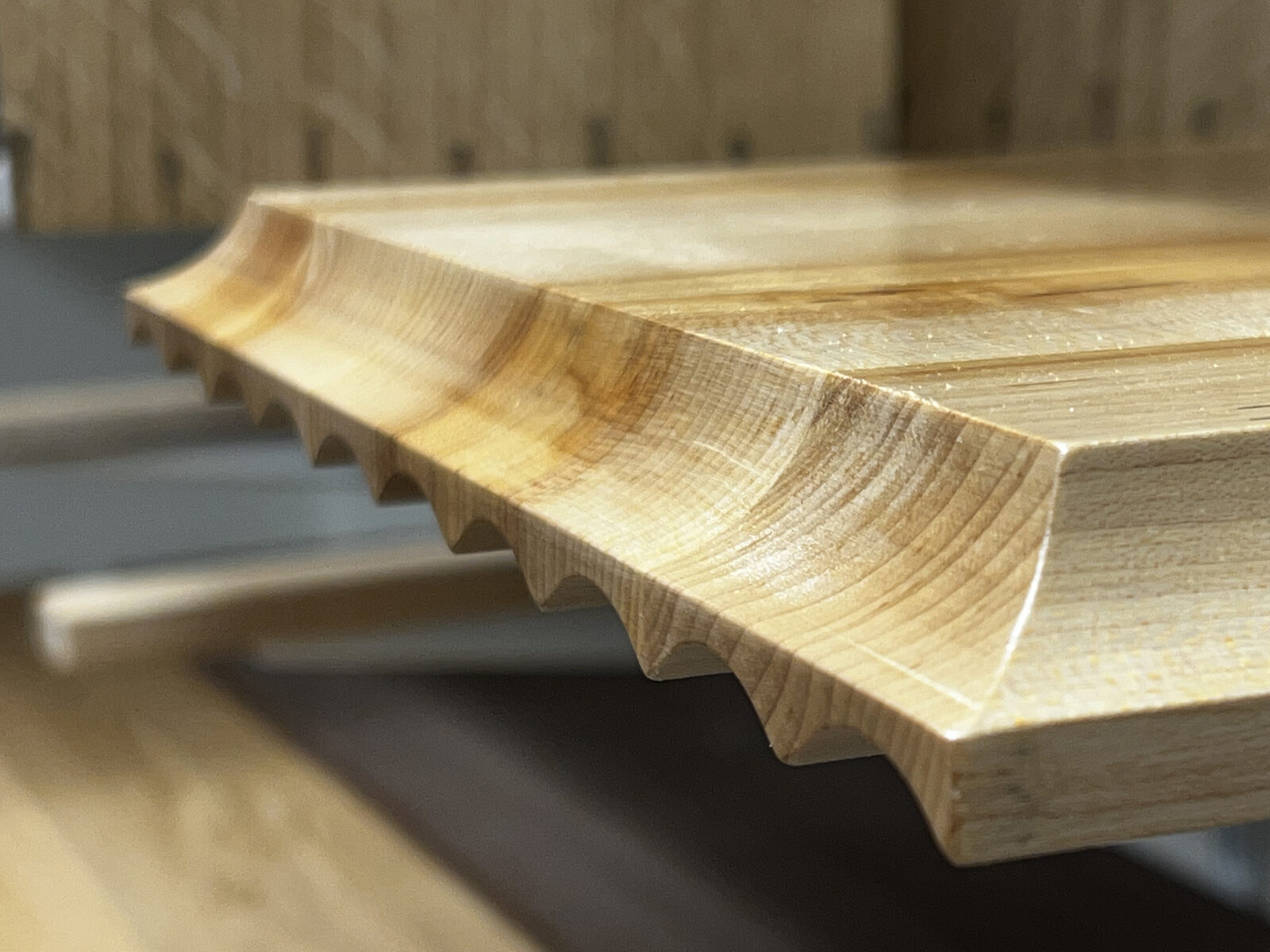
Permission comes before preference here.
Most towns produce one conversation about a bedroom: what has to go in it, how much of it hangs, what it should be made of. The Georgian stone townhouses in this town add a question in front of all of that, because a good number of them are listed and listing protects the inside as well as the front elevation.
For wardrobes the distinction is unusually clean. Taking out a modern fitted wardrobe and putting a better one in its place is a straight replacement of something that has no historic interest. Partitioning off the end of a bedroom to make a dressing room is a change to the plan form of a listed interior, which is an entirely different proposition and will generally need listed building consent before anyone measures anything.
So I ask which of those two you are actually describing at the first visit. It costs nothing to establish and it stops a design being drawn that cannot be built.
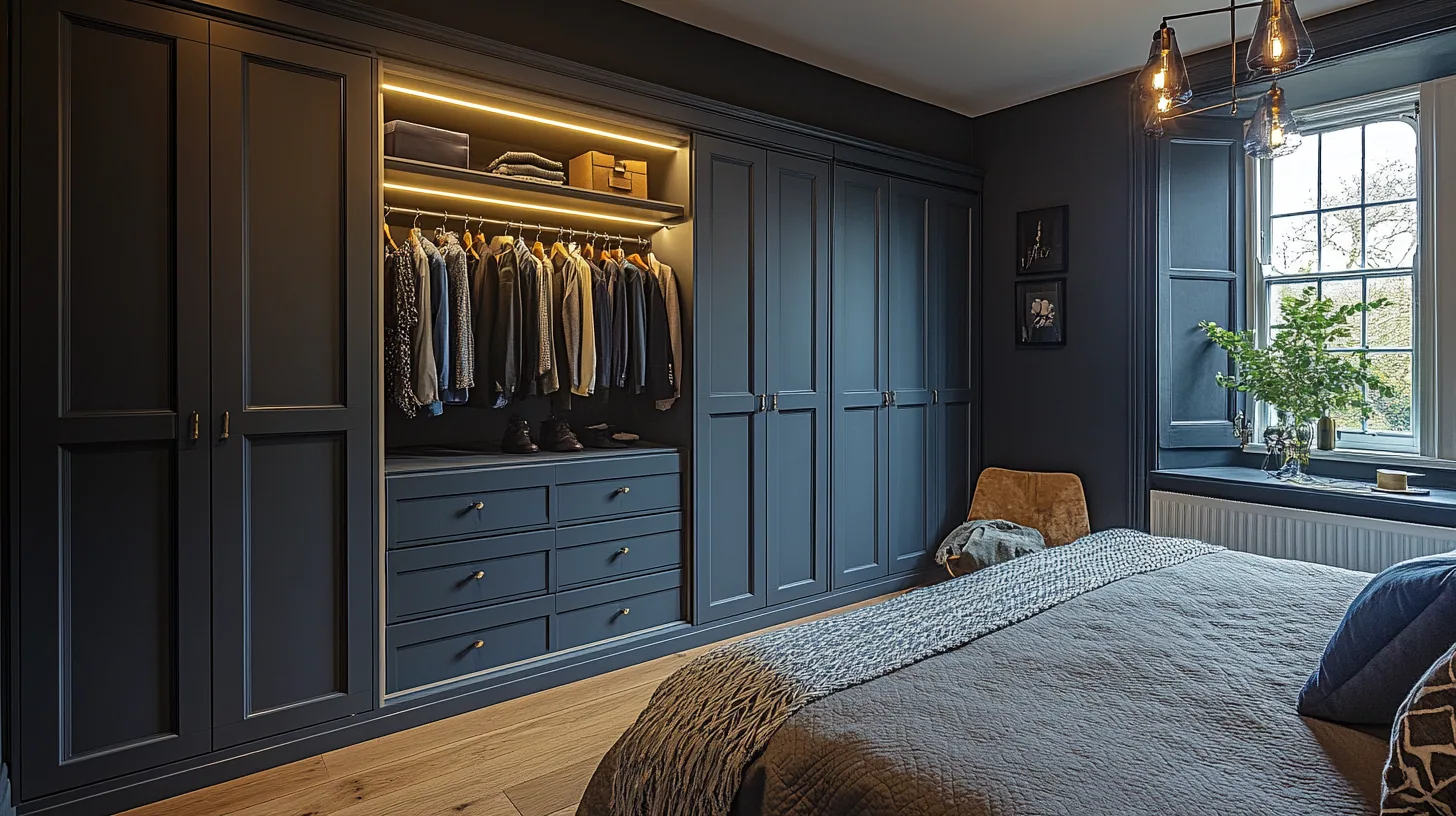
Drawn to sit alongside what the room already has.
Shutters, skirting, and the cupboard that came with the house.
Tall sashes in a townhouse of this date usually carry panelled shutters that fold back into boxes in the reveal. A run of wardrobes taken across that wall will jam them shut unless it stops clear of the box, and disabling an original working feature is precisely the sort of loss an officer will pick up on. It is also a shame, because those shutters do more for a bedroom in January than any curtain.
The skirting is the second constraint and the easier one. It is deep, it is usually original, and it should stay, so the plinth is scribed over it and the run steps out by the thickness of that moulding rather than the skirting being cut away to let a flat carcase sit back. The gain is that the joinery reads as though it belongs to the same era of the room.
The third is the press or closet many of these bedrooms already have beside the chimney. Keeping it, and drawing the new run to sit next to it as a deliberate pair, is nearly always the better answer. Removing it is the single move most likely to turn a wardrobe into a consent application.
A run that carries itself, and could leave without a mark.
Three metres of loaded hanging plus a set of solid doors is a great deal of weight, and the ordinary answer is to hang some of it off the wall. In a protected interior that is the wrong answer, so the carcases are braced to stand on their own and take everything down through a plinth to the floor, with the wall used only to hold the piece in position rather than to hold it up.
The plinth then spreads that load rather than concentrating it, which matters where the boards are original and screwing down into them is not on the table. Scribe fillets get pinned to the joinery, never to the plaster. Fixings, where they are needed at all, land in later material or in a sacrificial ground rather than in panelling or in original lath.
Built that way the whole run can be lifted out in a day, and the room is exactly as it was underneath. That is a good argument to be able to make when you are sitting opposite a conservation officer, and a better one for the next owner of the house.
The extra step is cheap. The wrong assumption is not.
Fitted wardrobes typically start from £5,000. On a townhouse of this kind the figure is moved less by the length of the wall than by the detailing: scribing over original mouldings, keeping shutters working, matching a door proportion to openings that already exist in the room, and building so that nothing bears on protected fabric.
Elevations for your room are part of the design work, and they are the drawings a conservation officer will want to look at if consent turns out to be needed. You get a detailed written quote before anything is ordered or cut, and the first consultation is free with no obligation.
West Oxfordshire District Council is the authority, not Oxford City Council, and the Woodstock conservation area was designated on 28 May 1975. The district has 51 conservation areas and permitted development rights are restricted inside them, which bears on external alterations and on what can be done to the outside of a building without an application. It does not usually control a wardrobe indoors.
Listing is the condition that does. If your house is listed, replacing modern fittings is generally acceptable, while work affecting original joinery, plaster, cornicing, shutters, floorboards or fireplaces will generally require listed building consent, and so will altering the plan form of a room to create a dressing area. Speak to the district council's conservation officer about the principle before the design is signed off, because it can change what gets drawn rather than merely delay it.
None of this is a reason to accept worse joinery. It is a reason to settle the question in the right order.
Other rooms in Woodstock.
Frequently asked questions
Can fitted wardrobes go into a listed townhouse?
Usually, provided the work is designed for a protected interior. Replacing an existing modern wardrobe is generally acceptable, while anything that affects original joinery, plaster, shutters or boards will generally need listed building consent from West Oxfordshire District Council first.
Does turning part of a bedroom into a dressing room need consent?
If the building is listed, almost certainly, because it changes the plan form of a protected interior rather than simply putting furniture into it. That is a different application from a straight wardrobe, and it is worth raising with the conservation officer before any layout is drawn.
Who administers the Woodstock conservation area?
West Oxfordshire District Council, which is a different authority from Oxford City Council. The Woodstock conservation area was designated on 28 May 1975, and the district has 51 conservation areas in total, with permitted development rights restricted within them.
Will a wardrobe stop my window shutters folding back?
It will if the run is taken blindly across the window wall, because the shutters need their boxes in the reveal to be clear. So the run stops short of the box, or the wall gets left alone entirely. Losing the use of an original shutter is not a trade worth making for another 400mm of hanging.
Do you have to cut out the original skirting?
No, and it should stay. The plinth is scribed over the moulding and the carcase steps out by its thickness instead, which keeps an original detail intact and gives the joinery a base that agrees with the rest of the room.
There is an old cupboard beside the chimney breast. Should it come out?
Rarely. If it is original it is part of what the listing protects, and removing it is the move most likely to require consent. Repairing it and drawing the new run to sit alongside as a matched pair generally gives a better room as well as a simpler application.
How is a wardrobe fixed if nothing can be screwed into the panelling?
By not relying on the wall for support. The carcases are braced to stand on their own and carry the load down through the plinth to the floor, with any fixings landing in later material or a sacrificial ground. The wall only keeps the piece in position.
Can the wardrobe be screwed down to the floorboards?
Where the boards are original, that is best avoided. A plinth that spreads the weight across the floor rather than concentrating it into fixing points does the job, which also means the whole run can be lifted out later and leave nothing behind.
My house is in the conservation area but not listed. Am I free to proceed?
For internal fitted joinery, generally yes. Conservation area status restricts permitted development for external work and asks that change preserves or enhances the area's character, and a wardrobe in a bedroom sits outside that. Confirm the listing status rather than assuming it, since the two are often mixed up.
What does this kind of work cost?
Fitted wardrobes typically start from £5,000, and in a house like this the detailing rather than the length tends to drive the figure. A detailed written quote comes before any timber is ordered or cut, and the first visit is free.
Let's make something
If you have a townhouse bedroom and you are not certain what the listing allows, that is the first thing to sort out and it costs nothing to ask. Come and show me the room, the shutters and the skirting, and you will get a straight view on what can be built.